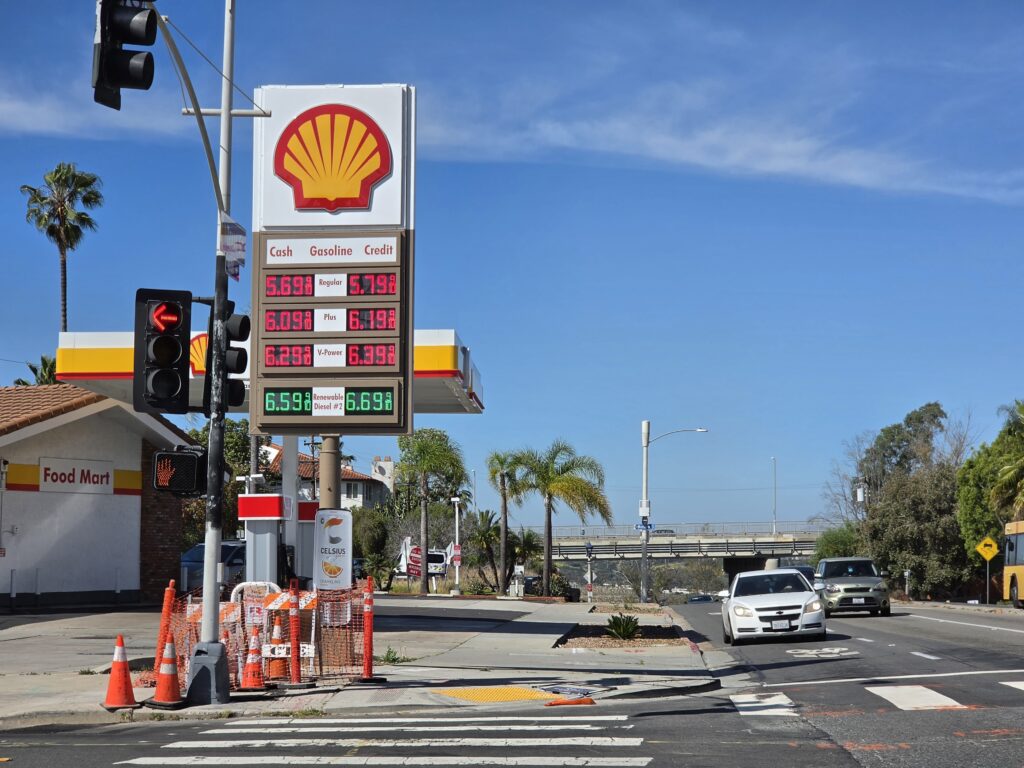
The price of gasoline at this Shell station (formerly Valero) is typically mid-range for the area; not the highest and by no means lowest. Less than two weeks ago, price at the pump was $4.30 per gallon. A few days ago, I paid $4.90. Now it’s $5.70.
Can you say, “Iran war?” Because that’s what is surely behind these rising prices that have yet to reach their ceiling. Americans will be impacted everywhere, from cost for fuel oil to gasoline, for starters, and rising costs of anything transported by air, land, or sea.
The pain will be felt in economies across the planet. Iran’s effective blockade of the Strait of Hormuz critically cuts off oil supplies to many Asian nations. China, Japan, South Korea, and Taiwan are among the countries that could all be impacted. Regionally produced exports like fertilizer and Sulfur are also restrained, and they are essential for producing Sulfuric Acid or growing crops.
Israel and the United Sates set in motion the current crisis with the assassination of Iran’s Supreme Leader, Ayatollah Ali Khamenei, at the end of February. The action followed weeks of organic protests and uprisings that reached and exceed the level of those during summer 2009. Iran appeared ripe for revolution. Instead, the country’s leadership readies retaliation, and actions that affect nations globally—not just we so-called infidels—create an aura of world war. The sacrifice of many for the sake of one is among the best definitions of evil, and that defines Iran’s wartime response.
The question many people ask: Why now, Mr. President? I can’t answer for him.
Let’s talk Featured Image, captured today using Galaxy S26 Ultra. Vitals: f/2.4, ISO 25, 1/1667 sec, 69mm; 3:13 p.m, today.