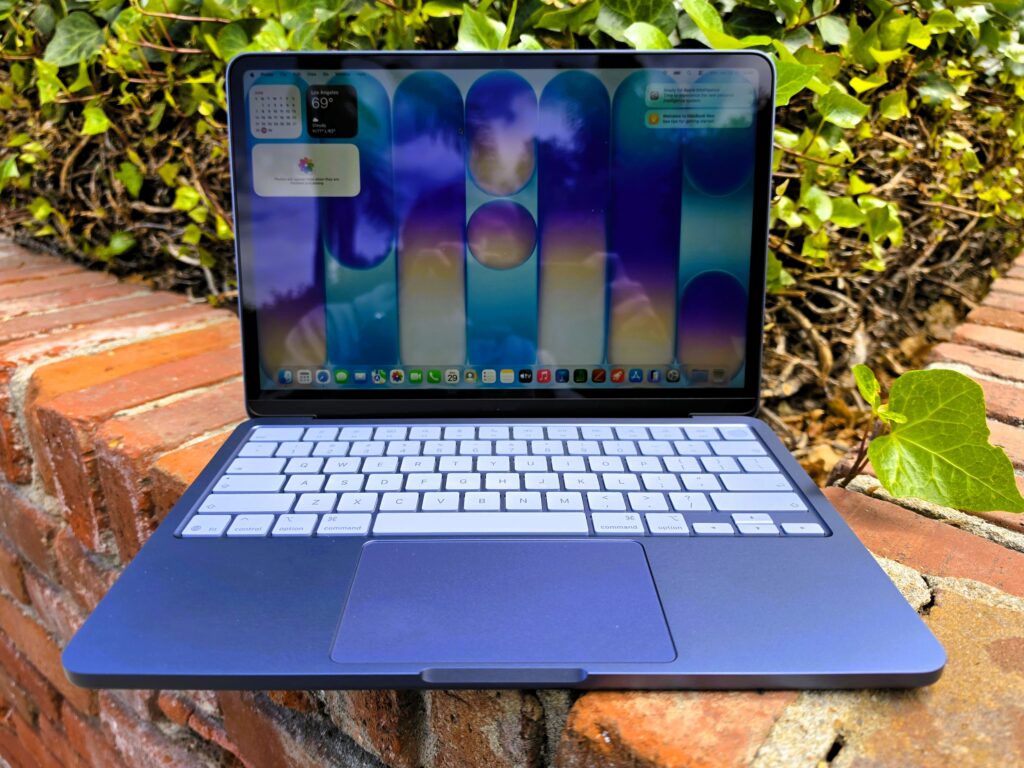
If you are an iPhone and/or iPad owner who has pined for a somewhat affordable Mac, if you aren’t rushed and don’t mind waiting, and if you are bestowed with Herculean patience, then Apple MacBook Neo is for you. If you don’t mind paying $100 more than you would have five days ago, by all means partake the forbidden fruit.
For the record, other than anyone fitting the above criteria—or perhaps someone wanting to be one of the cool kids—I don’t recommend MacBook Neo for almost anyone who does more than surf the web or check email. Lag is the best term to describes how the Neo feels in real world usage. Performance reminds me of early Chromebooks, other than Google’s own Pixel series, and also Netbooks. Remember those?
Value Questioned
Let’s talk why, starting with the basic specs as basis. To keep selling price—well, before last week’s $100 increase—affordable, Apple outfitted the laptop with a smartphone processor: The A18 Pro chip, which packs a 6-core CPU and 5-core GPU. Memory: 8GB. The combination might work on an iPhone running iOS but it lags on a MacOS laptop. And an iPhone owner will see the difference immediately and feel it in real world usage. The Apple smartphone smoothly flows while the laptop lags and stutters.
Neo is pretty (four colors) and sturdy (aluminum enclosure) for the price range. Think of the Neo like this: Hefty car that looks fabulous but packs a 4-cylinder engine into a six- or eight-cylinder chassis. The vehicle gets great gas mileage but accelerates slowly when stopped at a stoplight or when trying to pick up speed on the highway.
Sorry, Apple tree huggers, many people you convince to embrace MacBook Neo will be disappointed by how much they must wait for the laptop to respond. That experience will remind them of computers of yesteryear that tried their patience. Those kinds of buried emotions will, when revived, further crimp the overall user experience.
More Needed
Early Chromebooks suffered similar shortcomings for essentially being underpowered. Google’s operating system was pretty lean but stuttered from insufficient RAM (typically 4GB and occasionally 8GB) and slower Intel processors. Chromebook Pixel demonstrated what the platform needed to succeed: Faster microprocessor and more memory (16GB). My guess is the latter would massively reduce lag on MacBook Neo. For the record, no modern laptop should ship with only 8GB of RAM, regardless the operating system.
Stating things differently. Unless you desperately need or want MacOS, you could get similar or better user experience from a Chromebook costing hundreds of dollars less. Comparably priced Windows laptop from the likes of Acer or Dell (among other manufacturers) will pack more memory and a touchscreen.
The thing that made MacBook Neo compelling was pricing. The laptop launched for $599 and $699 in 256GB and 512GB versions, respectively. Educational discount lopped off $100. While underpowered, the chassis is aluminum not plastic and the glossy display is bright and vibrant. Those benefits kind of worked at $499 for students. The math doesn’t add up following the price increase. The additional hundred bucks breaks the price-performance barrier.
DOA?
So, is MacBook Neo dead on arrival? Apple sure seemed to be selling a whole heap many of them—before the price increase. The answer depends on priorities. While overly reflective for my tastes, the 2408-by-1506 resolution, back-lit IPS display, at 500-nits, is quite pleasing. Battery life is exceptional. For example, during a Zoom meeting last night, the Neo licked about 10-percent or so from the battery indicator. For the same hour-plus video conference, Samsung Galaxy Book6 Ultra would have slumped by twice to three times more.
Video camera is comparable to others capturing1080 HD. Speakers are tinny, though. The trackpad is overly clicky for my tastes. There is a fingerprint sensor on the more expensive model but no backlight for the keyboard on either configuration.
Among the real reasons to choose MacBook Neo are the exceptional battery life, impressive IPS display, and design and construction. Then there’s MacOS.
My Indigo
The price increase stings; I wouldn’t spend $699, even $599 as a student, for the 256GB variant. But I did spend about that much, after tax, for the 512GB model by buying refurbished. On June 24, during Amazon Prime Day, I came upon the higher-end Indigo Neo for about $50 less than the new 256GB model. I put the refurb in my shopping cart and left it overnight.
I awoke the next day to news that Apple had raised prices—or, for the 512GB Neo, $200 more than the Amazon refurb—before adding sales tax. To my surprise, the laptop was still in my shopping cart. I purchased, hoping the Neo would solve some legacy problems: Accessing Mac-formatted portable hard drives with files I needed.
To my surprise, the box had original seals and the charging brick and cable were new. Nevertheless, I wiped the operating system and started fresh. Always be wary of rootkits and malware with refurbished computers. Will I keep it? It’s a secondary device, so likely. The aforementioned lagging and stuttering would drive me nuts as primary, or only, PC.
What Purpose?
Everything comes down to purpose and how a device fits what you may need. I own Pixel Tablet, which is grossly underpowered but was affordable when purchased two years ago. Its utility increased when the Google-made case went on sale and I bought one. The kickstand conveniently can be used as a hook. I hang the thing from a kitchen cabinet handle and listen to educational videos on YouTube while washing dishes. The tablet is used every day. The thing has purpose.
Perhaps through prolonged use, MacBook Neo will find purpose that gives it value. Even now, a refurbished or used unit could make sense for some people, because of cost. But, new, at essentially $700 or $800 before tax, MacBook Neo is a pretty purchase that lacks the brawn necessary for immediate or long-lasting satisfying end user experience.
Let’s talk Featured Image, which comes from Samsung Galaxy S26 Ultra. Vitals: f/1.4, ISO 64, 1/2000 sec, 23mm (film equivalent); 11:13 a.m. PDT, today.