Given the chaos going on in Afghanistan right now—what the Aug. 21-27, 2021 Economist cover rightly calls “Biden’s Debacle“—perhaps Tripadvisor needs to update its travel pages for Kabul. With tens of thousands of people fleeing […]

Given the chaos going on in Afghanistan right now—what the Aug. 21-27, 2021 Economist cover rightly calls “Biden’s Debacle“—perhaps Tripadvisor needs to update its travel pages for Kabul. With tens of thousands of people fleeing […]
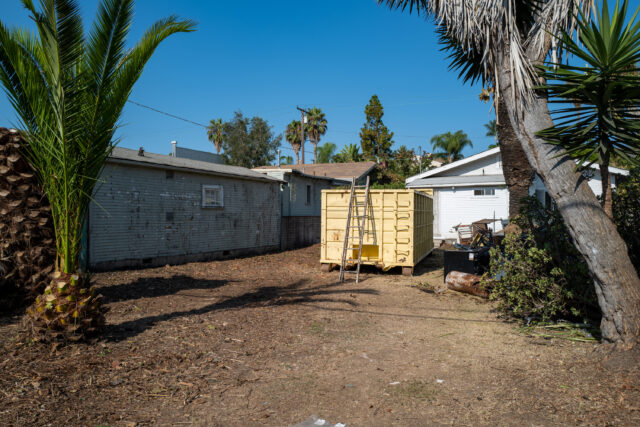
If only SARS-CoV-2 (severe acute respiratory syndrome Coronavirus 2)/COVID-19 eviction moratoriums applied to feral felines, the habitat of Mimi and Sweet Pea would not have been utterly destroyed. The luscious, and humungous, yard they shared was intact a few days ago—my wife and I can’t recall if Tuesday or Wednesday (today is the only Friday the 13th of the year). This morning, we peaked in—shocked to see nearly complete clearcutting.
The saga starts as we walked along the alley separating Alabama and Florida. As we moved down the block between Monroe and Madison, I saw a kitty beyond the cross street going towards Adams. From the coloration, and our recently seeing Pace (pronounced paw-chay, according to his owner) in the vicinity, I assumed it must be the aged Norwegian Forest Cat. Oddly, though, the animal disappeared and reappeared, as if going into and out of different backyards along the alley.
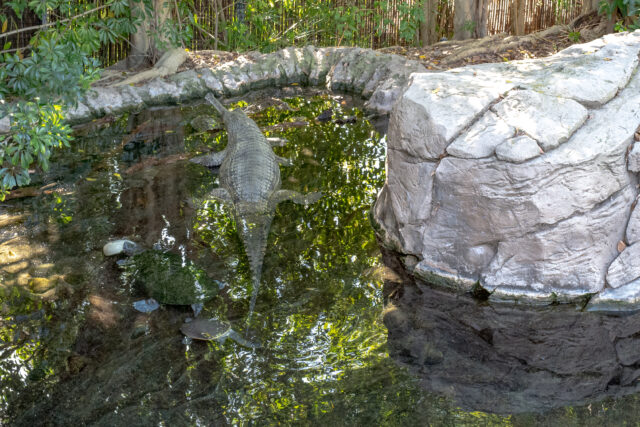
When my wife and I last visited San Diego Zoo, on July 21, 2020, we debated about whether or not to renew our residential membership before it expired. With much of California locked down in response to SARS-CoV-2 (severe acute respiratory syndrome Coronavirus 2)/COVID-19—and closures returning—we decided to wait. Had we anticipated a forthcoming price increase, maybe our decision would have been different.
Our 2-adult annual pass during 2018 was $112, if I rightly recall, and either $129 or $149 when renewed. We could have re-upped for $160, with an offer that expired 10 days after our last walkabout among the critters. Since then, the animal refuge switched to individual-only pricing. For comparable benefits as before, which include no blackout dates, our combined renewal rate would be $218, which by my math is a 36-percent increase over our last renewal offer and 95-percent more than our 12-month pass purchased three years ago.
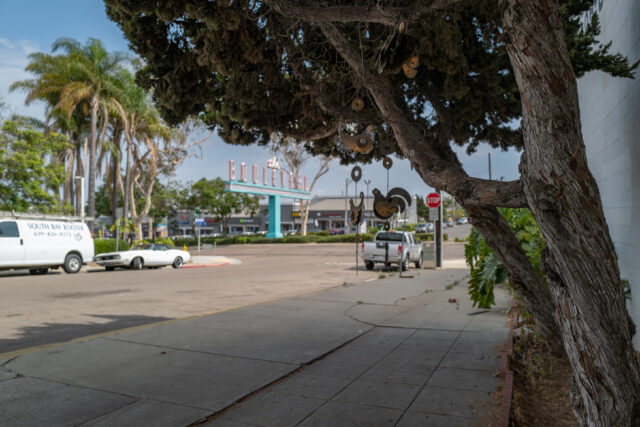
I rarely walk along Georgia Street between El Cajon and Meade but traipsed there today, hoping to see either Husky or Romper—both profiled in my “Cats of University Heights” series after separate sightings. Approaching El Cajon, I came upon the oddest thing: a metal mobile hanging from a tree alongside the outside wall of a commercial building. I wondered: Why here? Home decoration makes sense, but before a facade of bricks? How odd. That said, what’s more appropriate than birds in a tree?
Location presented excellent opportunity to capture mobile and The Boulevard sign in the background. The Featured Image, which is composed as shot, comes from Leica Q2. Vitals, aperture manually set: f/4, ISO 100, 1/640 sec, 28mm; 3:41 p.m. PDT. In post-production, I experimented with several different lighting scenarios—one that silhouettes tree and metallic birds—before choosing the one you see.

Maybe you heard how high are gas prices in California compared to most other states. The Featured Image attests to the gouging that we experience at the pumps. In a nice twist, and keeping with the Cal progressive push for equity, all grades cost the same. Well, if you’ve got to pay more, all the same is a small, but not meaningless, consolation.
Alas, the equity price hike didn’t last long. Hours later, regular grade sold for $4.06 a gallon. Now there’s a tactic for making you feel good about the high cost of gasoline. Four bucks six cents seems so reasonable when you could pay $4.83 more. (Wink. Wink.)
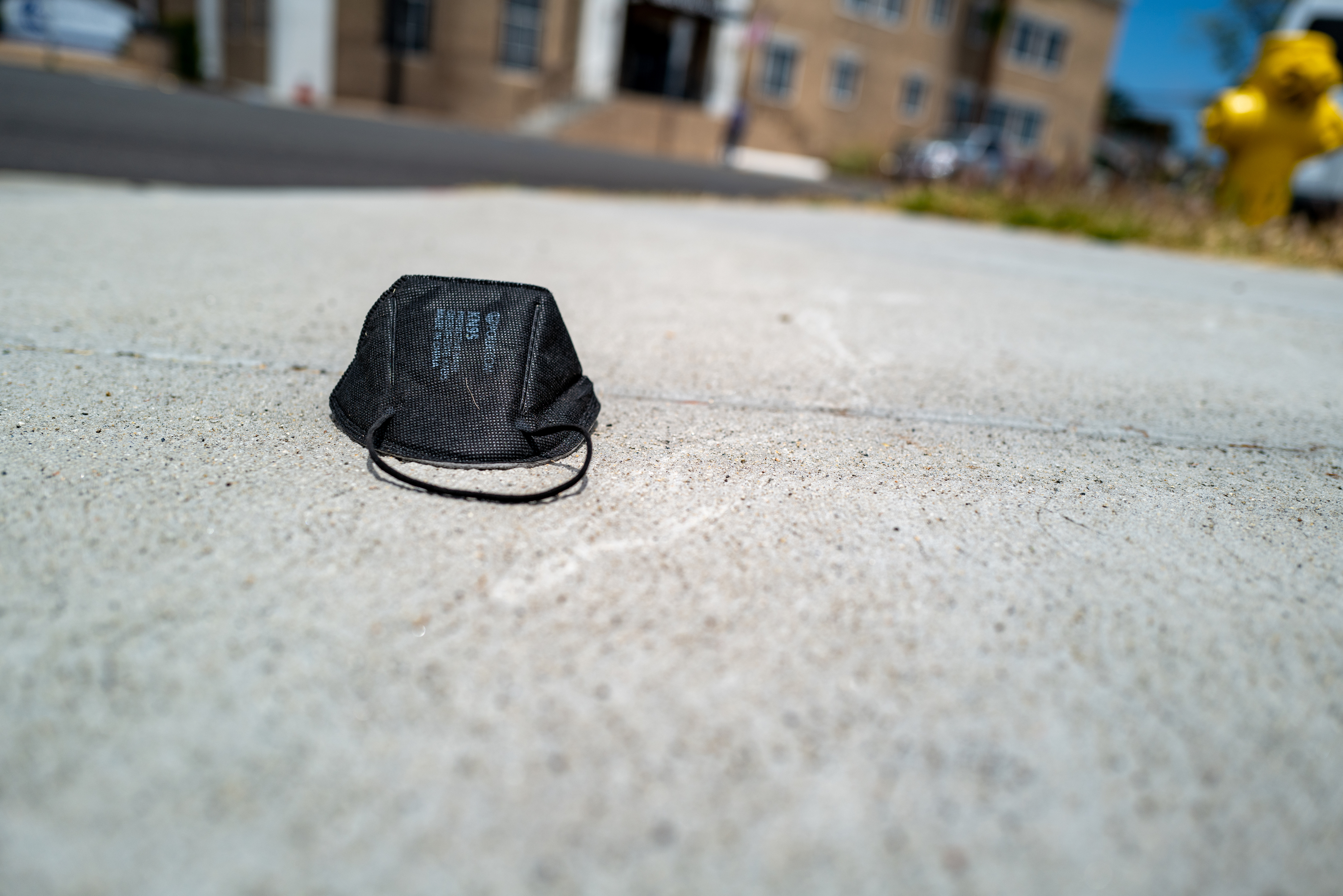
What a difference a year makes. In April 2020, when SARS-CoV-2 (severe acute respiratory syndrome Coronavirus 2), which causes COVID-19, seemed so dire and face masks were so difficult to find, I wrote about the perils of not wearing one—illustrated with a rare, discarded protective covering. Now the Centers for Disease Control and Prevention advises that vaccinated individuals no longer need to wear masks, or social distance, in most situations—meaning: “except where required by federal, state, local, tribal, or territorial laws, rules, and regulations, including local business and workplace guidance”.
Long before the unexpected change to pandemic public policy, just two days ago, face masks could be found littered all about the County. San Diego Union-Tribune spotlighted the debris along beaches in July 2020; early last month, ABC News reported that “discarded masks litter beaches worldwide, threaten sea life“; the local CBS affiliate, reporting about the April 24, 2021 “19th-annual ‘Creek to Bay Clean-up'”, explained that there has been a surge in ‘single-use plastics”— and the “biggest offender? PPE [Personal Protective Equipment], especially masks”.
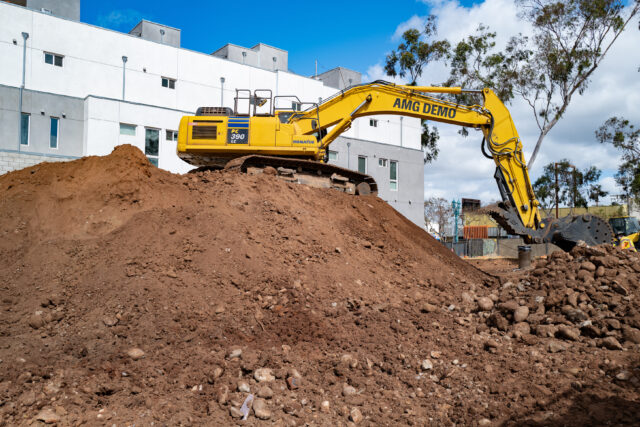
The big digger seen at the corner of El Cajon and Mississippi on April 12, 2021 triumphs atop a mountain of dirt upon which once stood three buildings; in San Diego’s University Heights neighborhood. Someday soon, another cathedral of unaffordable housing will rise like the Tower of Babel.
My prediction: Cities all over the country are currently overbuilding to accommodate the massive Millennial population from which fewer babies are being born. Fast forward a decade, perhaps just five years, and rising Baby Boomer deaths coupled with falling birth rates will lead to a glut in housing—particularly multi-family properties. Is this construction site one of many future ghettos?
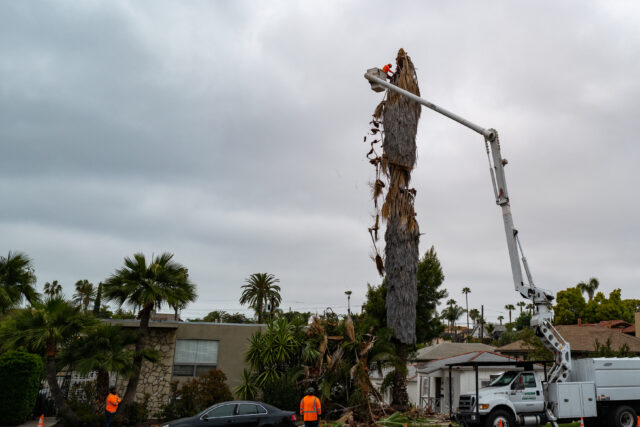
And that’s not the worst of the devastation. Nearly three months ago, I wondered about the fate of the mighty palm after high winds ripped fronds from the trunk. Then, unexpectedly, on the First Day of Spring, under the direction of cute cottages’ new owners, men with chainsaws started clearcutting a lush landscape of shrubs, succulents, and trees around the buildings. The bearded tree is the last to go.
Every nearby neighbor to whom I have spoken about the destruction of the urban jungle is shocked. No one can fathom why the massive deforestation. Late this afternoon, one homeowner, who has lived in University Heights for more than two decades, told me that water can’t be the reason. He and his wife maintain a lovely backyard of flowers, plants, and trees, without wasteful watering.
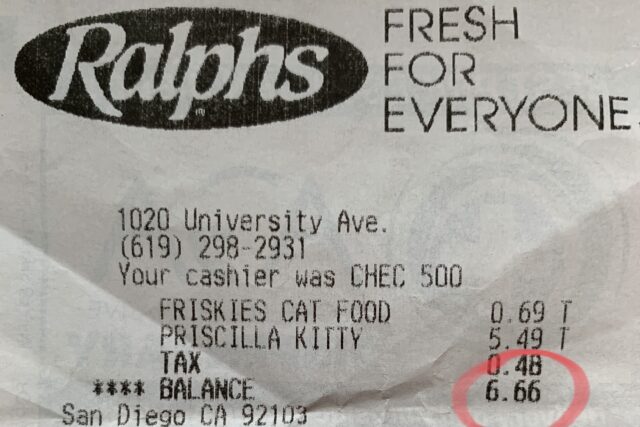
Uh-oh. Some Bible scholar correct me if I am mistaken. Isn’t that the number of the Beast? On my grocery receipt. For cat food!
Bad as that is—and I lie not: Hours ago, when I started writing this post, my website fatally crashed. I had to enter Recovery Mode and remove an important plugin, which, oddly, comes from the same developer as the blogging system. You would think the company’s stuff should work rightly together.
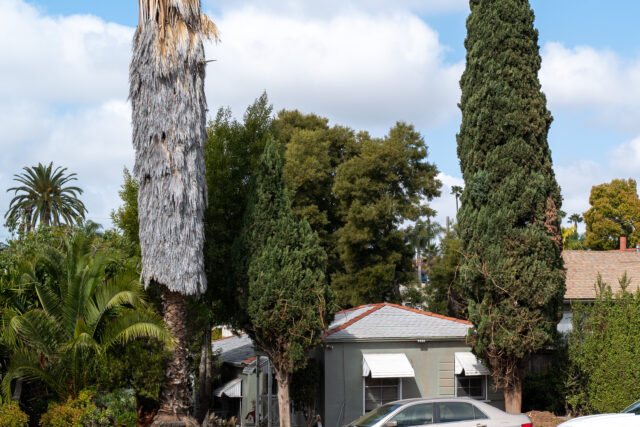
This morning, my wife rightly suggested that yesterday’s before photos aren’t enough to show just how brutal was the massacre of palms, shrubs, succulents, trees, and other green growing things before and among one of the neighborhood’s rental properties.
Compare the Featured Image to the one from the previous post. Those buildings and windows were obscured by a lush, well-tended, tropical jungle. My understanding: The pruning, and perhaps reconstruction, is planned to continue all week. That means the bearded tree to the left may also be removed.
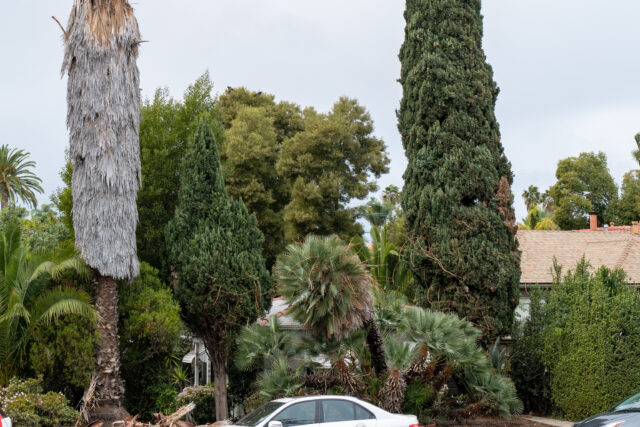
Sometimes changes occur so abruptly and unexpectedly in my San Diego neighborhood of University Heights, I regret not documenting what was—never anticipating that the thang could be gone. The tree outside our primary windows and palm at Cleveland and Monroe are examples. Today’s loss, on the inappropriately-timed first day of Spring, was catastrophic for some of my neighbors, who were reminded: renters have no say.
Calico Harley resides in a row of cute cottages that, until this afternoon, were almost completely obscured from view because of the variety of succulents and trees growing in front of the property and down the side. The well-tended, and healthy, jungle was lush and lovely. When workers started cutting down a single tree this morning, I complained to my wife about another horticultural butcher job. What I could never imagine is how devastating would be the clearcutting. For today, I refrain from showing what is. Let’s look at what was.
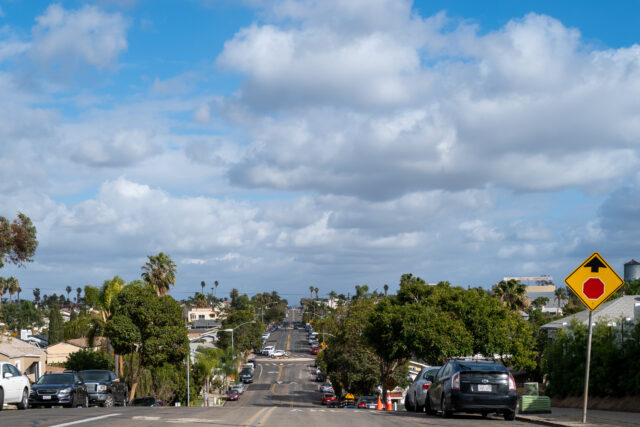
My relentless criticism of so-called “traffic calming measures”—part of the future Georgia-Meade bikeway—continues with a current look down Meade from Georgia. Click on the Featured Image hyperlink and take a close look at the activity at Alabama, where is the first of the traffic circles that replaces stop signs.
You are witness to a near accident—as two vehicles converge from different directions. Who should yield to whom isn’t always obvious, which is gravely complicated by poor visibility for some approaching vehicles and the speed with which many drivers enter the roundabout intersections. I can’t imagine how much more dangerous will these circles be when the route officially opens to bicycles.