With nuclear holocaust threatening to spill out of North Korea into Asia, or even America, I can’t resist dusting off this previously unpublished photo from April 9, 2017. Vitals: f/2, ISO 200, 1/70 sec, 23mm; […]

With nuclear holocaust threatening to spill out of North Korea into Asia, or even America, I can’t resist dusting off this previously unpublished photo from April 9, 2017. Vitals: f/2, ISO 200, 1/70 sec, 23mm; […]
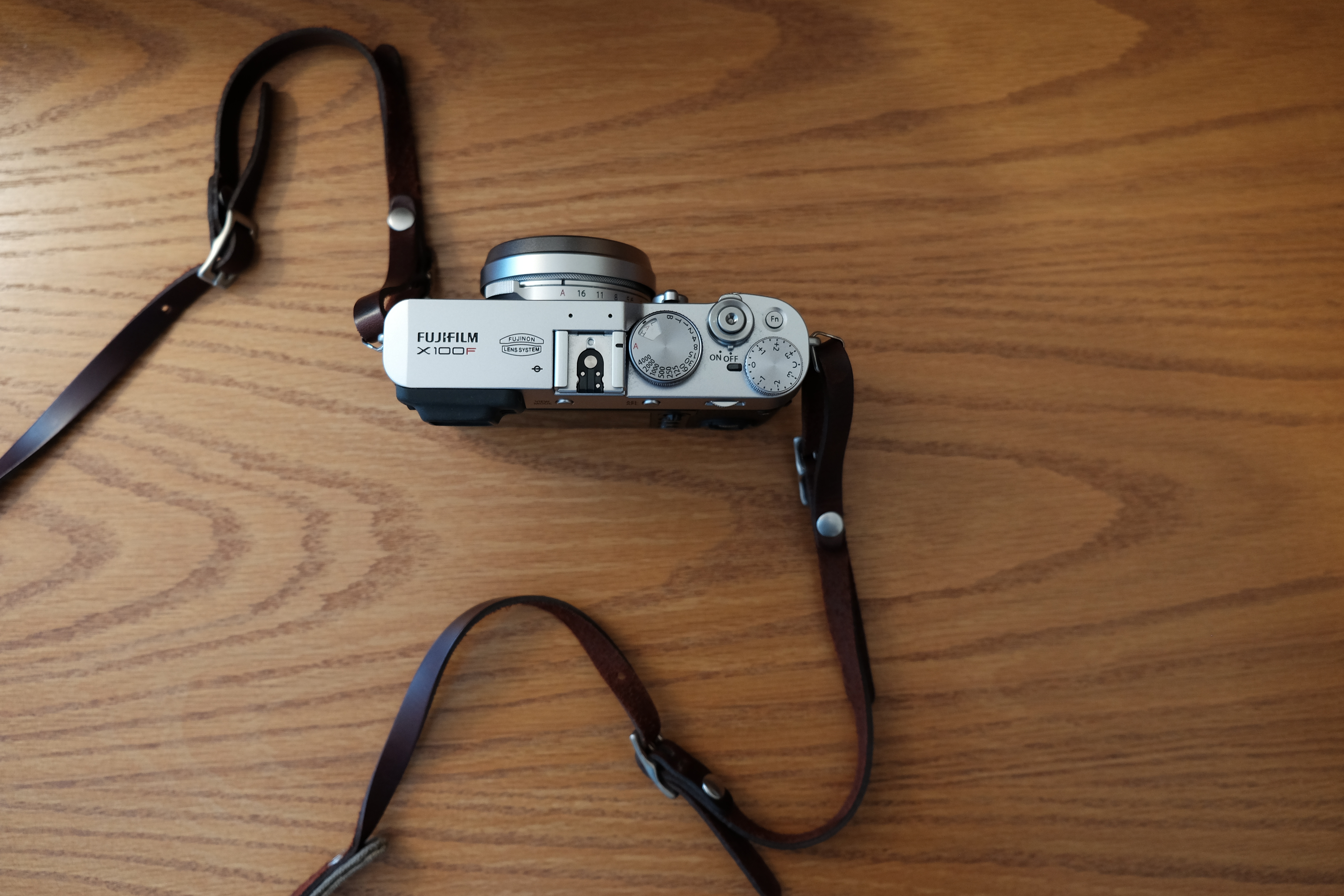
During the camera film era, Fujifilm battled kingpin Kodak with brighter, more vibrant colors that either photographers loved or hated—perhaps both. That was last century. In the 21st, Kodak is a shadow cast against aged Kodachrome, while its rival has successfully transitioned from print to digital—and with amazing bravado. Fuji’s transformation started six years ago with the cleverly-engineered, retro-designed X100, which I reviewed in May 2011.
The compact digital camera’s success led Fuji to develop a series of additional bodies and lenses; all are designed with professional shooters in mind. The X series family features compact, mirrorless designs that incorporate digital SLR-size sensors and manual controls—meaning dials and buttons to directly manipulate settings rather than rely on software menus. The X100 line—from the original to the S, T, and now F—remains the most distinctive for how well features and benefits balance set against truly innovative design concepts.

Yum. Yum. Moment captured on April 23, 2017 at 6:03 p.m. PDT using the Fujifilm X-T1 and XF18-55mmF2.8-4 R LM OIS kit lens, with Classic Chrome simulation set. Vitals: f/4, ISO 200, 1/1250 sec, 55mm. The birds are […]

One benefit living in sunny San Diego: We can leave a window open year around—rain, shine, or chill—for the cats. At the choice location, near the front door, is a red IKEA Lack table, from […]

For the second time ever—and within a month—my wife and I visited San Diego Zoo yesterday. I was surprised to see another feather-brain nesting with the flamingos. Vitals for the moment captured using Fujifilm X100F, with […]

Where Madison Ave. ends here in San Diego’s University Heights neighborhood, one can look down the canyon into Mission Valley and see the Pacific Ocean off in the distance. I captured the moment, while walking […]

This sign, spotted for the first time today, adorns the yard where lives Pepe, whom I featured in the Cats of University Heights series on March 9, 2017. His owners have two preschool children and another feline, and I wonder what prompted the warning because of yesterday’s sad sighting: A dead cat on the side of the road, a block-and-a-half further down Cleveland Ave. towards Washington Street.
My wife and I came upon the short-hair, tiger-tabby while walking to the bank to close out her dad’s account. Annie gasped, seeing the poor creature first. My immediate concern: That he was the three-legged feline that lives two houses away. He appeared in the Cats series on Nov. 13, 2016. Luckily not. Having photographed more than 50 furballs around the neighborhood, I was grieved to stand over the kitty, which someone had mercifully moved to the curb.

The Fujifilm X100F is, conceptually, little different from the original that released in early 2011. Refinements are plenty, reaching the fourth generation (hence the F): focusing is way faster; sensor packs more megapixels (24 vs 12); and controls are more sensibly placed and functional, for example. But largely the same: overall retro-rangefinder styling; shape and size; emphasis on manual dial controls; leaf shutter; ND filter; dual optical and electronic viewfinders; and fixed f/2 lens, among others. Why change what is classic, and clever, from the start?
The Prime lens, matched with the 24.3-megapixel X-Trans CMOS III sensor, delivers fantastic IQ (e.g., image quality). Surprisingly, the X100F is more an action-cam that conceptually is in league with interchangeable siblings X-Pro2 and X-T2. Focus finally is fast enough. I got a good taste of both qualities while shooting surfers from Pacific Beach pier. Some of the best captures are black and white, applying Acros film simulation in camera. The Featured Image and two crops following below the fold demonstrate.

My wife and I hauled off to the closest tourist beach earlier today; one of her favorite bead stores had advertised a sale. While she shopped, I walked down the Pacific Beach boardwalk. At 11:11 a.m. PDT, I came upon a blonde, back turned, tapping on a smartphone. Her shapely thighs, wavy hair, and posture beckoned for a spontaneous, stealth shot (no face). I grabbed the Fujifilm X100F, right-shoulder slung on the ONA Lima strap, and framed the moment—when she shifted position and turned to face me just as I clicked the shutter. Did she psychically feel the camera?
The close-cropped “Accidental Portrait” is the result. That’s the PB pier off to the right, BTW. Vitals, aperture manually set: f/11, ISO 200, +0.33 ev, 1/250 sec, 23mm. All color photos in this post were purposely shot with Classic Chrome film simulation but accidentally with the positive value exposure compensation.

My mom was in the hospital earlier this week—and not for the first time in recent months. On March 29, 2017, I walked about the neighborhood while chatting with her on iPhone 7 Plus; left hand to left ear. Over my right shoulder, from the ONA Lima strap hung the Fujifilm X100F, which I am loving for its convenience, easy-carrying, and one-handed operation.
While ambling up a steep street, I spotted a cute arrangement of child collectibles nestled under a tree. Without interrupting the conversation, I pulled off the lens cap, spun the aperture ring from f/11 to Auto, turned on the camera, and clicked the shutter with my right hand—crouching down for better perspective as I looked through the optical viewfinder.

Today, the Wilcox couple visited San Diego Zoo for the first time in nearly 10 years living in Southern California, after signing up for a year’s membership. Annie had been to the animal habitat once before, in 1987, with her dad.
His passing, two months ago, is mixed blessing. We have time to be tourists, and in ways we wouldn’t have chanced previously. One, or both, of us stayed close by—particularly during the last 18 months of Bob’s life. We relocated from the Washington, DC area in October 2007 to enable him to live independently in his own apartment. Needs grew more demanding during the last two years, as his energy and mobility, but not mental acuity, diminished.

Yes, you are experiencing déjà vu. We have been to this yard before—three times in six days. The furballs are resident pets of the “Wildlife Habitat”, as an official sign states. They must have a time-sharing arrangement, as cats are quite territorial. While walking to The Hub, my wife and I spotted Ash (his real name) around 1:20 p.m. PDT today. I observed the other two, Sebastian and Booger, in mid-morning and late-afternoon, respectively, on different days. The Maine Coon is about two years old and vision-impaired.
I captured the moment using Fujifilm X100F, with Velvia film simulation. Both pics are crops—the Featured Image 100 percent. That one is Anne’s preferred composition, and the other (below the fold) is mine. In both, the framing attempts to use the stones to lead the eye to the kitty. I shot the first photos with aperture manually set to f/8; they didn’t make the cut because Ash was turned away nibbling a plant. The keepers are auto-everything—and meant to see how well the camera handles contrasting light (in the yard) and shadows (where is the cat). Except for slight straightening and the aforementioned cropping, the two portraits are not tweaked for light or color, beyond what the camera does.