Where does four years go? By my recollection, before yesterday’s expedition, my wife and I hadn’t visited the Spruce Street Suspension Bridge since late-May 2017. The Featured Image (warning: 33MB file), captured using Leica Q2, […]
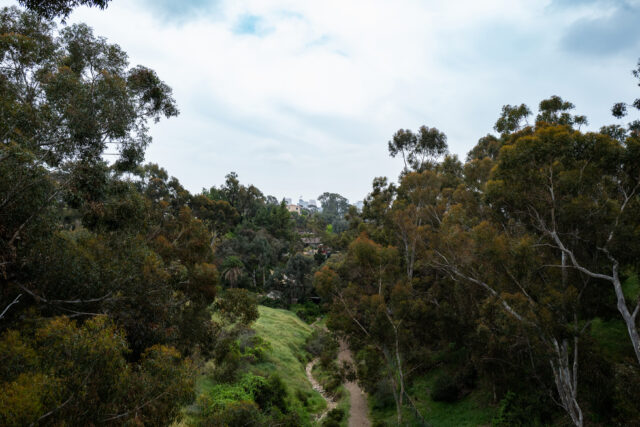
Where does four years go? By my recollection, before yesterday’s expedition, my wife and I hadn’t visited the Spruce Street Suspension Bridge since late-May 2017. The Featured Image (warning: 33MB file), captured using Leica Q2, […]
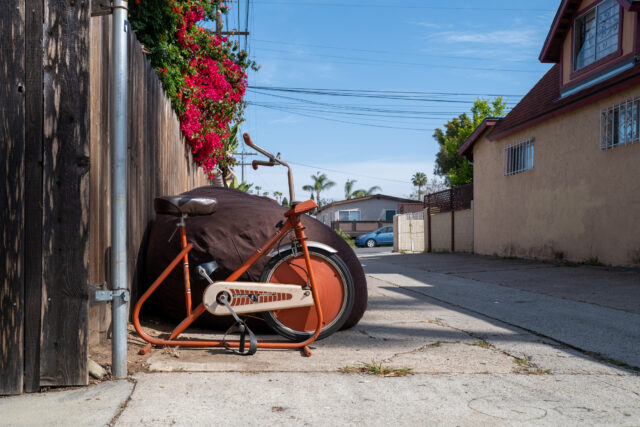
A few days ago, an overstuffed beanbag—suitable for someone of great heft—appeared in the alley between Alabama and Mississippi at Monroe in University Heights. San Diego residents frequently leave unwanted things for foragers to take. What’s that saying about one person’s trash being another’s treasure?
Today, my wife and I happened to pass by, seeing a new addition: The Vitamaster Slendercycle prominently placed in the Featured Image and companions. Vitals, aperture manually set: f/5.6, ISO 100, 1/400 sec, 28mm; 9:50 a.m. PDT. The second, composed as shot, is 1/200 sec, 9:51 a.m. I used Leica Q2 for both. The last, added after posting, is a closer crop of the first.
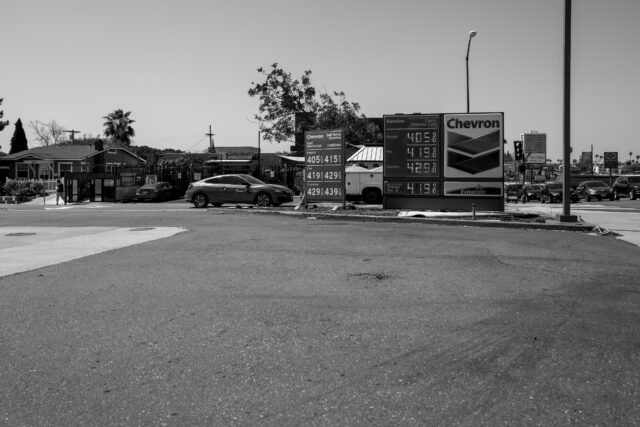
Someone tell me where Joe Wallace lives, because I want to go there. Yesterday morning, I read his Wall Street Journal story, “Leap in Gas Prices Puts $3 a Gallon in Sight“, in state of disbelief. In sight, as in coming? Because here in San Diego, that reference means looking back. We passed three bucks a gallon well more than a month ago. In fact, before President Executive Order killed off the Keystone Pipeline, the price had been $2.86 for months—and that was up 30 cents from Summer 2020—at my local economy filling station.
“Gasoline prices at pumps in the U.S. hit an average of $2.88 a gallon over the past week, according to the AAA”, Joe writes. “In California, the most expensive market, average prices stand at $3.88, according to AAA”. Hours later, I shot the Featured Image, with Leica Q2 Monochrom, specifically to illustrate this essay. Granted, Chevron charges more than many competitors but not outrageously greater than the $3.88 at nearby Valero.
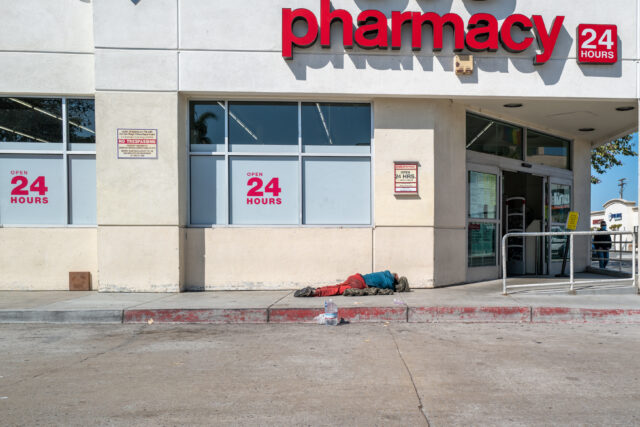
During my thirteen-and-a-half years living in San Diego, I have resisted taking any photos of the city’s thousands of homeless—whose presence is more pronounced by the day. They deserve dignity, rather than exploitation by street shooters. But, today, the sorry state of a gentlemen sprawled out nearby the entrance to a pharmacy in Hillcrest demanded attention, and mention, so here we are with a Featured Image and companion captured using Leica Q2. Vitals, aperture manually set: f/5.6, ISO 100, 1/1000 sec, 28mm; 11:02 a.m. PDT. The other is same but 1/1250 sec.
I was aghast at how casually people walked by the man, who was stretched out in death-like position facing the building. He was an obstacle that passersby moved around. No one bothered to see if he was alive (after some long observation, I detected breathing). I was immediately reminded about history lessons and news stories read during my grade school years about the USSR—people lying dead in the streets and Soviet citizens walking around them; commonplace sightings, presumably, become part of the background of life. Is that really what we have come to be in the United States of America—or in what I unaffectionately call Communist California?

Drizzle falls in my San Diego neighborhood of University Heights this fine Monday morning. Before the rain, while walking along the Alabama-Mississippi alley between Madison and Mission, I came across this old sofa—the kind of […]
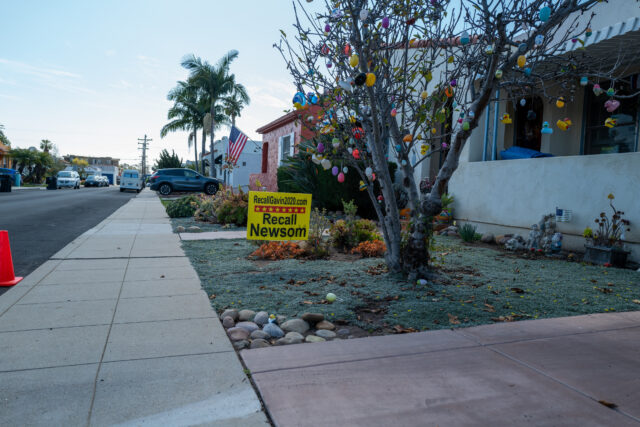
Some things go so oddly together that you must stop and regard them and wonder. Today, while walking along Shirley Ann Place in San Diego’s University Heights neighborhood, a “Recall Newsom” sign surprised me; it’s the first one seen anywhere here. My wife fixated on the Easter eggs hanging from a tree in the same yard. She missed the one thing, and I the other. Mmmm, what does that say about selective vision and being drawn to what interests you while having a blindspot for what doesn’t?
As strangely as the cheerful eggs and hopeful sign are juxtaposed, something else made the scene feel even more Twilight Zone-like: The house beyond with the American flag flew something different before the Presidential election: Old Glory with spray-painted BLM. Well, I couldn’t leave without photos, which were captured using Leica Q2. The Featured Image (warning: 27MB file), which is composed as shot, shows the street. The cropped companion brings together the three elements. Vitals, aperture manually set for both: f/5.6, ISO 100, 1/200 sec, 28mm; 12:25 p.m. PST. The other is f/2.8 and 1/640 sec.
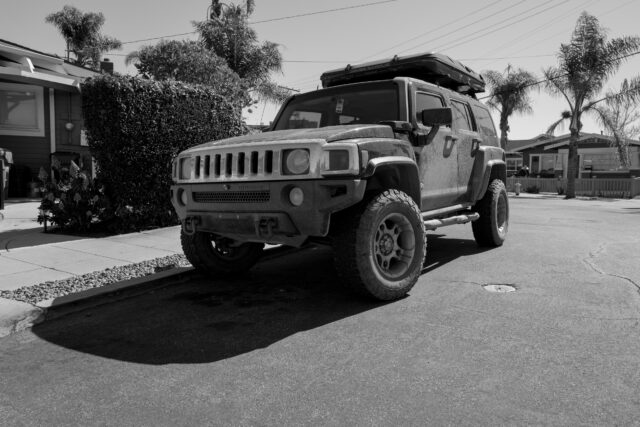
San Diego changes around me, particularly from the cost-of-living increases brought by the ever-growing emigration of high-tech workers escaping Northern California; they’re well-paid and find here comparatively affordable rents and home prices—all of which rise as more Googler-types relocate. SARS-CoV-2 (severe acute respiratory syndrome Coronavirus 2)/COVID-19 lockdowns set them free to work from anywhere there is reliable Internet.
So I was only modestly surprised to see a Hummer parked off of Lincoln in the University Heights neighborhood on Feb. 21, 2021. What amazed me more, when arriving here in October 2007, was the number of Hummers seen seemingly everywhere. You could have played an adapted Punch Buggy—and lost—for the few non-military Hummers traveling about the Washington, D.C. metro area that we left nearly 14 years ago. In San Diego, the contrast was stark, and I wondered why all the gas guzzlers given stereotypes about carbon-aware, environmentally-focused California culture. Should I answer status symbol? The late-2008 economic collapse purged the oversize vehicles from local roadways. Who could afford higher monthly payments or gasoline for a roadster rated city driving of 13 miles to-the-gallon? By mid-2009, their numbers had diminished to near nothing; that I observed. Eventually, as the economy recovered, based on increasing sightings, various Jeep models replaced the Hummers as all-around utility vehicles.
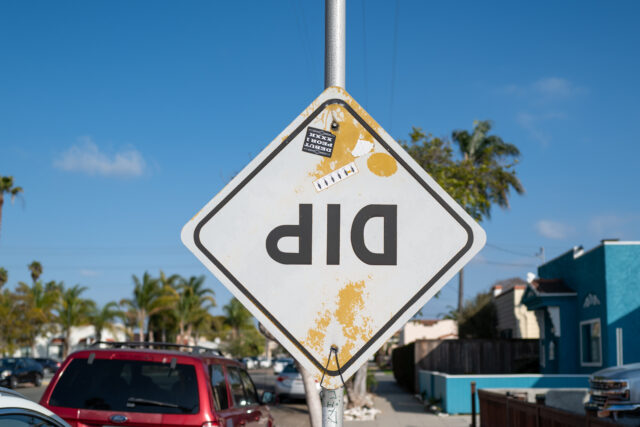
While walking along Monroe, approaching Utah, in San Diego’s North Park neighborhood, a street sign beckoned my attention. Consider the Featured Image, captured using Leica Q2, as a metaphor for all things unimaginably crackers about the Golden State. Vitals, aperture manually set: f/2, ISO 100, 1/5000 sec, 28mm; 2:54 p.m. PST, Feb. 10, 2021.
We could start with the SARS-CoV-2 (severe acute respiratory syndrome Coronavirus 2)/COVID-19 lockdowns that have devastated California’s economy; compelled tens of thousands of businesses to permanently close; put millions of people out of work and unable to pay either rent or mortgage; prevented landlords and lenders from collecting the aforementioned and prohibited them from evicting tenants and homeowners; forced families or individuals into homelessness; kept kids out of school for 11 months and counting; opened the prisons, releasing potentially dangerous individuals into the population (many of these former inmates become homeless); and—hell, that’s long-enough list of misery.
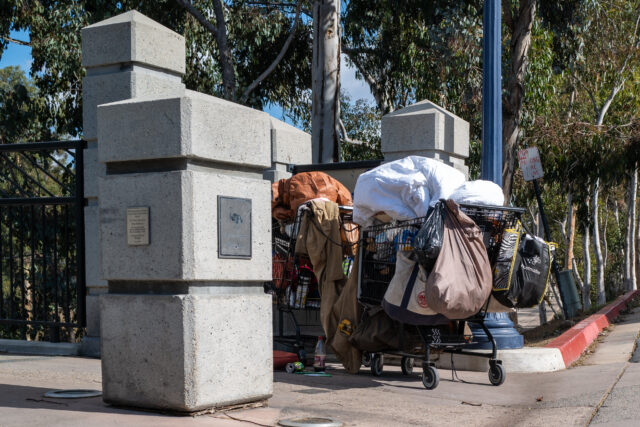
I specifically shot the Featured Image, yesterday using Leica Q2, to illustrate this essay. Vitals, aperture manually set: f/5.6, ISO 100, 1/400 sec, 28mm; 11:22 a.m. PST. The carts belonged to one of three homeless men gathered together a few meters away on the Hillcrest side of Vermont Street Bridge (University Heights is on the other). For sure, San Diego has a significant indigent population. But I write about San Francisco and something that surprises me—and perhaps will you, too.
According to the SF Chronicle (sorry, subscription required), the city is “currently sheltering more than 2,200 homeless people in about 25 hotels” and the “monthly program costs range from $15 million to $18 million”. By my math, that works out to between $6,818.18 to $8,8181.82 per person each month. If these people were paid, the equivalent annual salary would be between $82,000 and $98,000. Oh, and looks like the United States government will cover costs through the end of September 2021.
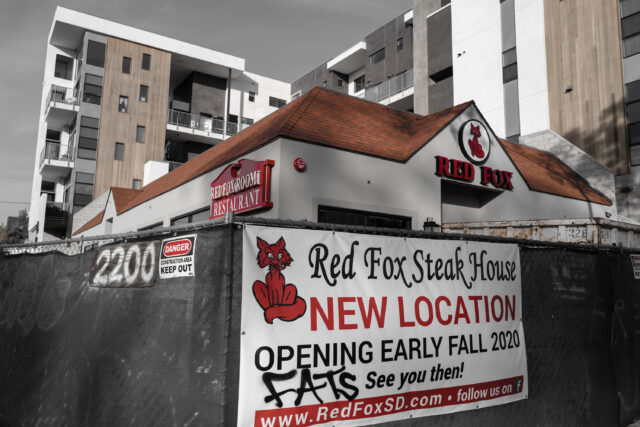
I am so tempted to buy a can of spray paint and replace that last zero in twenty-twenty with a one. Because given that Southern California’s COVID-19 crackdown continues unabated—and that the restaurant couldn’t have opened in “Early Fall” because of it—autumn twenty-twenty-one looks ever more realistic. That assumes the place isn’t forced into insolvency, like so many other local eateries. In this County, SanDiegoVille keeps a running list of restaurants and pubs permanently shuttered during 2020—the majority since the pandemic’s start. I count 113 entities, but more when accounting for establishments with multiple locations.
These businesses are prohibited from seating customers, indoors or outdoors; take-out and delivery are the only options, and they don’t generate enough revenue to keep operations aloft. The widening spread of COVID-19, which is caused by SARS-CoV-2 (severe acute respiratory syndrome Coronavirus 2), demonstrates that forced closures are ineffective killing the pandemic. But they sure look likely to massively massacre small- and medium-size businesses.
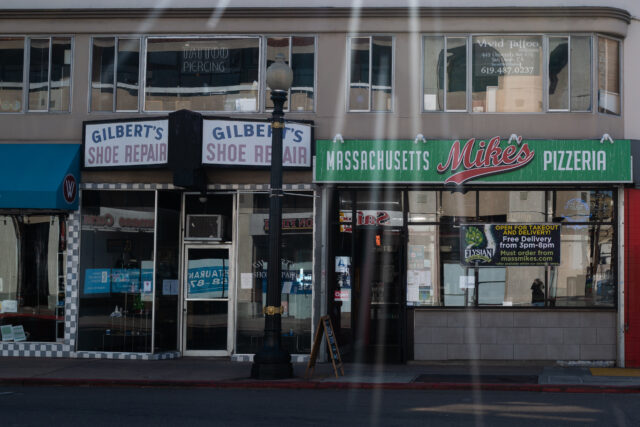
They say that a picture is worth a thousand words. Sometimes you need a second one to communicate the message. I captured the Featured Image today along University Ave. in San Diego’s Hillcrest Neighborhood. “Massachusetts” is correctly spelled in the billboard for Mike’s Pizzeria.
Digressing, why New England pie? I recall there being a New York pizza place in the location before it joined the many shops and restaurants that have closed thanks to the overly onerous lockdowns imposed by Governor Gavin “Gruesome” Newsom. He acts like some quirky, hallucinogenic-taking medium blessed him as the messiah of COVID-19—the disease caused by SARS-CoV-2 (severe acute respiratory syndrome Coronavirus 2). He will kill more people (and businesses) than he will ever save; he attacks the pandemic with the figurative equivalent of atomic bombs. Will someone please hide the launch codes before radioactive fallout kills us all!
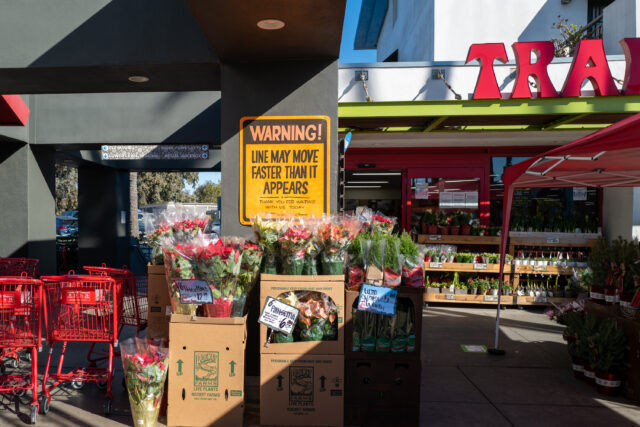
What? Trader Joe’s management thinks that some impatient, cart-ramming Millennial will run down great-grandpa pushing his walker? These are the perils of the newest Governor “Grinch” SARS-CoV-2 (severe acute respiratory syndrome Coronavirus 2)—also known as […]